
46 vs 28: The Shuttle Test, and Why Agility and Power Matter More After 30 Than You Think

Week 1 of the Evolve Fitness fitness challenge: Tim Walker, 46, takes on Mario, 28, in a test of speed, agility, braking and power. Mario won by one second. That is the point.
Most people track one fitness number.
Their weight. Their bench press. Perhaps their waist measurement.
Almost nobody tests how quickly they can accelerate, stop, change direction and produce force. Yet those abilities quietly matter more as you get older.
So I am running a series of challenges against Mario, one of our personal trainers. He is 28. I am 46. That is nearly 20 years between us, although I prefer to describe it as a useful research project rather than an age-related humiliation.
Each week, we will test a different attribute of fitness.
This week: speed, agility, braking and power.
The result: Mario 2:03. Tim 2:04.
We made up the test because we were in the gym and wanted something that challenged more than straight-line running.
We called it the Evolve Ladder.
The result was simple:
| Competitor | Age | Time |
|---|---|---|
| Mario | 28 | 2:03 |
| Tim | 46 | 2:04 |
Mario won.
By one second.
I am also carrying a slightly troublesome knee, which I mention for context rather than sympathy. The point is not that a 46-year-old should always match a 28-year-old. The point is that training matters.
A 46-year-old personal trainer with a dodgy knee stayed within one second of a 28-year-old trainer in a demanding test of acceleration, deceleration and repeated changes of direction.
That is a story about preparation, not talent.
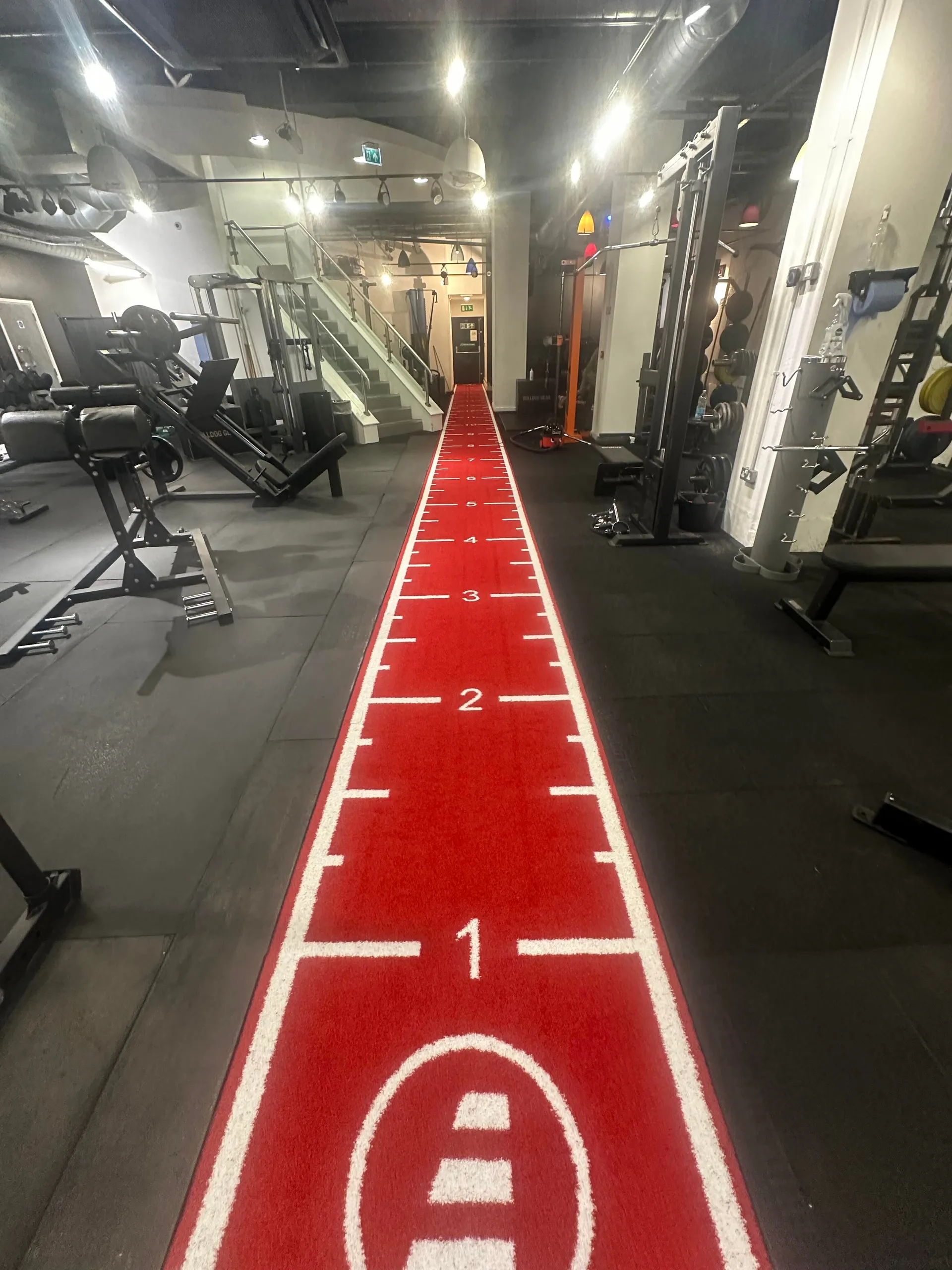
The Evolve Ladder: 420 metres and 40 turns
Here is the protocol.
Set up a straight 20-metre course. Mark every metre from 0 to 20. Shoes, water bottles or chalk work perfectly well as markers.
Start at 0 metres.
Run to the 1-metre marker, put one hand on the floor, return to the start line and touch it. Then run to 2 metres and back. Then 3 metres and back.
Continue all the way to 20 metres.
The total distance is 420 metres, with 40 changes of direction.
Every turn asks you to brake, lower your centre of mass, control your body and push away again. This is not simply a running test. It is a repeated test of speed, braking, balance, coordination and power.
Only got a hallway, garden or small patch of ground? Use the 10-metre version. That gives you 110 metres and 20 changes of direction.
There are no published norms for this exact protocol. We are not going to invent any.
That means the useful benchmarks are clear:
- Under 2:04, you beat a 46-year-old personal trainer with a dodgy knee.
- Under 2:03, you beat Mario.
- The most important target is your own previous time.
You can download the full Evolve Ladder protocol sheet and norms PDF and take it to a park this weekend.
Three similar tests that do have numbers
The Evolve Ladder is useful for tracking yourself, but it is not a published clinical or sporting standard. These three tests have reference numbers attached to them.
1. The 4 x 10-metre shuttle
This is a shorter agility check.
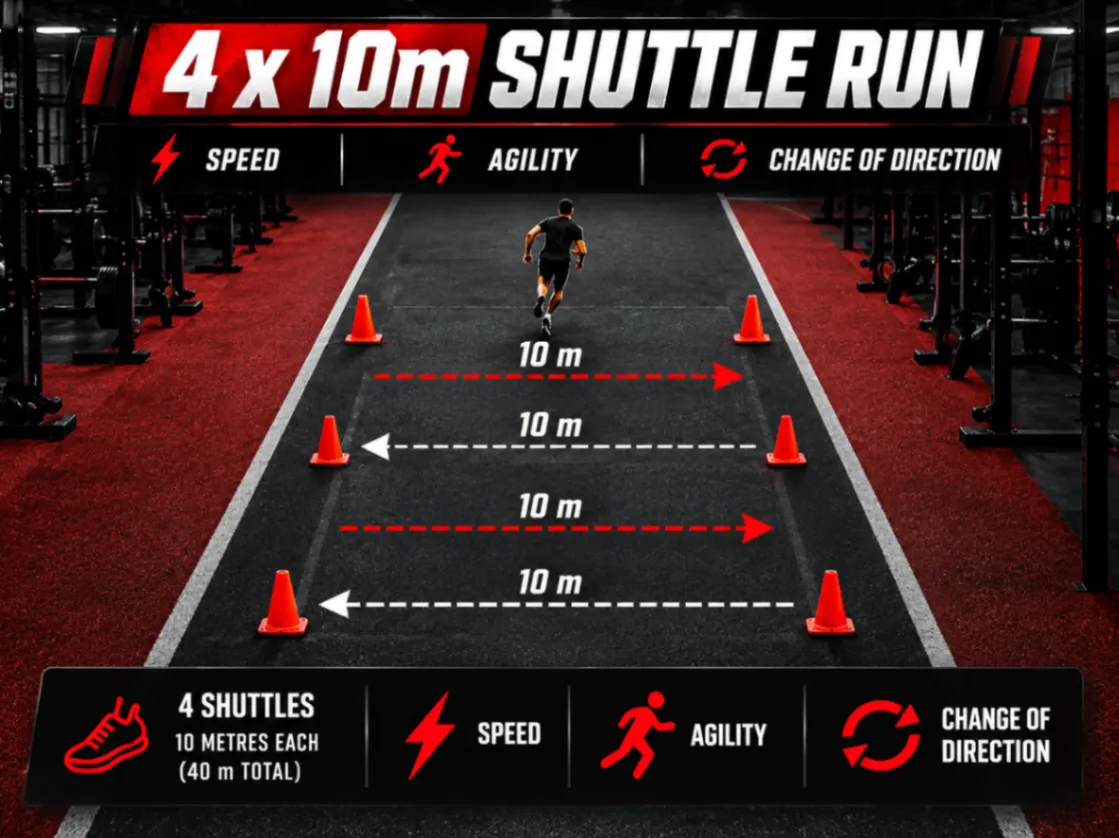
Set two lines 10 metres apart. Run there and back twice, covering 40 metres in total. Both feet must cross each line, and you swap a small object at each end. Complete two attempts and record your best time.
The following averages come from 230 Spanish adults aged 18 to 64 in the ADULT-FIT project. They are population averages, not targets.
| Group | Average time |
|---|---|
| Men, all ages | 10.9 seconds |
| Women, all ages | 13.8 seconds |
| Age 18–34 | 10.7 seconds |
| Age 35–49 | 13.2 seconds |
| Age 50–64 | 14.2 seconds |
| Active adults | 10.1 seconds |
| Inactive adults | 13.7 seconds |
The “active adults” figure needs context. Most of that active group were young, so it flatters the average. Do not treat 10.1 seconds as a universal standard.
The ADULT-FIT research found the test was highly reliable when timed properly, making it useful for tracking change over time.
Source: Castro-Piñero et al., Time measurement validity and reliability of the 4 × 10-m shuttle run test in adult population: The ADULT-FIT project, Journal of Science and Medicine in Sport, 2023. Read the study.
2. The 300-yard shuttle
This is a much more demanding conditioning test.
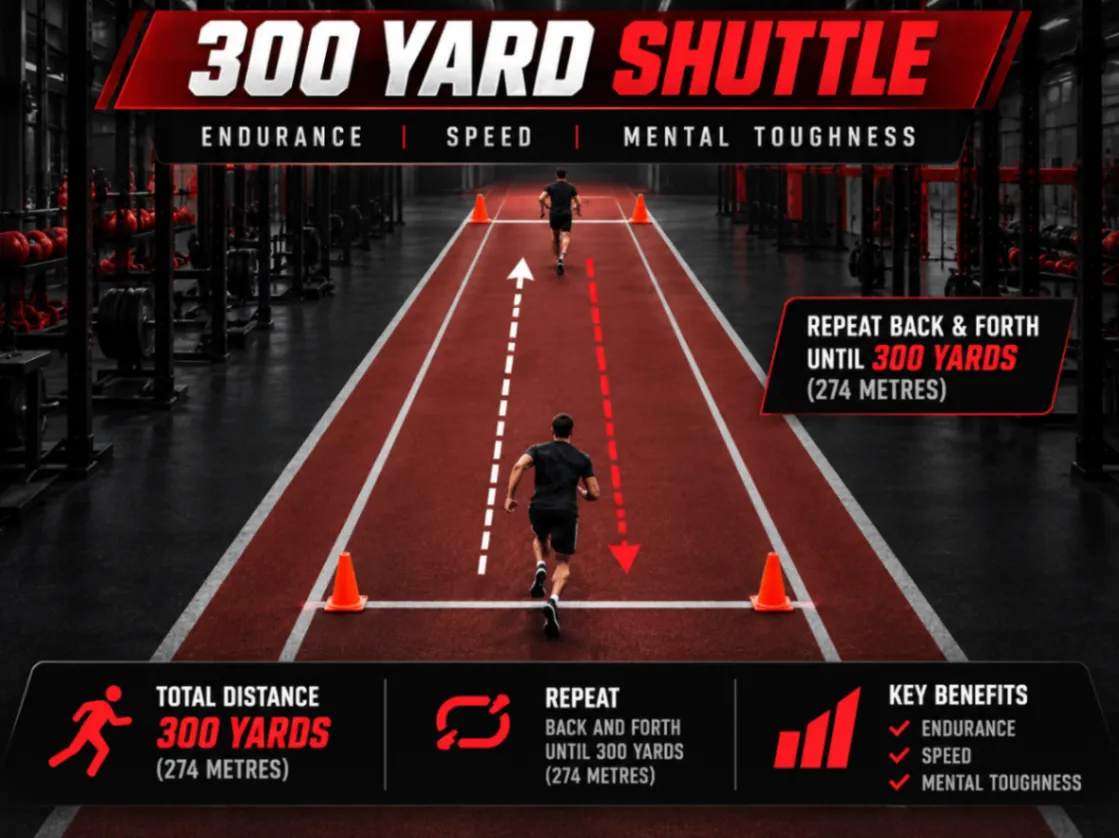
Set two lines 25 yards apart, or approximately 23 metres. Run six round trips, touching each line. Rest for five minutes, then repeat the test. Your score is the average of both attempts.
| Rating | Time |
|---|---|
| Outstanding | 52 seconds |
| Very good | 54 seconds |
| Good | 57 seconds |
| Average | 62 seconds |
| Below average | 65 seconds |
| Poor | 68 seconds |
These are athlete standards from wrestling conditioning, not everyday adult norms. Most people over 40 will start well outside them.
A difference of less than three seconds between your first and second run is considered outstanding. That tells you something about repeated-sprint ability and conditioning, not just agility.
Source: Carmen Bott, Conditioning for Wrestlers, via Get Physical.
3. The suicide
Basketball’s favourite punishment.
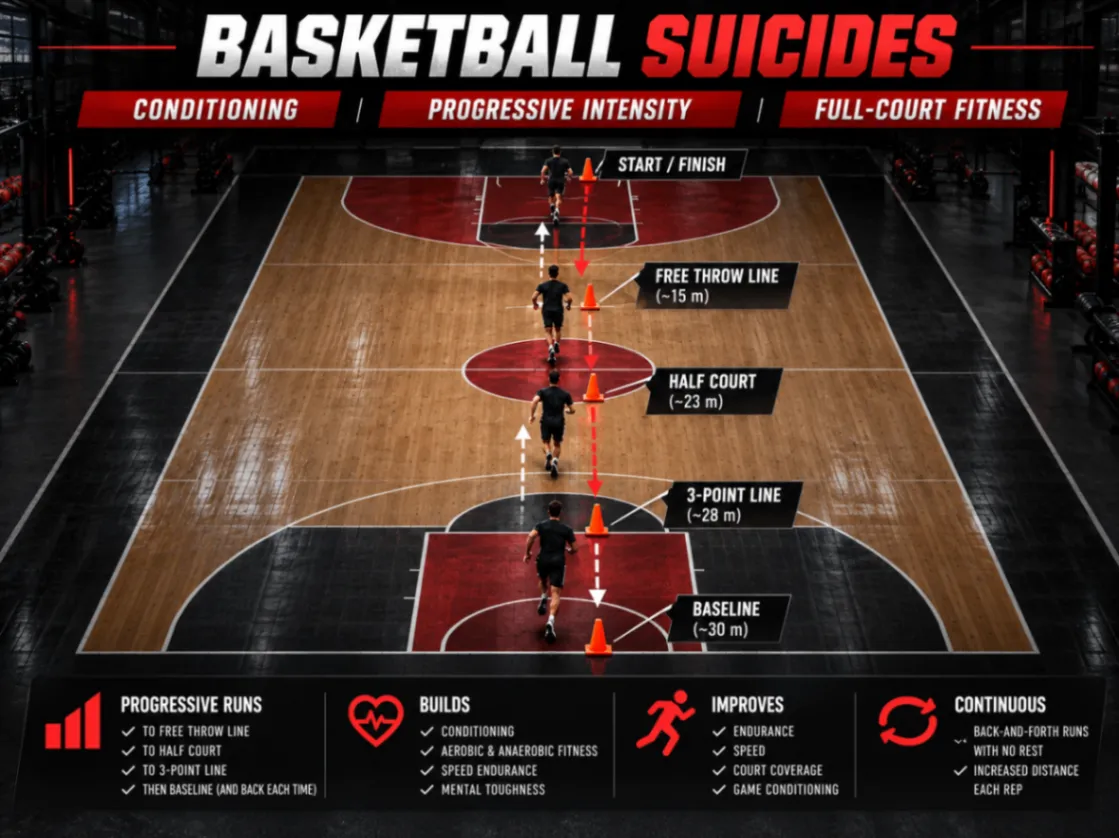
Use cones at 6, 14, 22 and 28 metres. Run to each cone and back to the start, touching the line with your hand before returning.
| Section | Distance |
|---|---|
| 6 metres and back | 12 metres |
| 14 metres and back | 28 metres |
| 22 metres and back | 44 metres |
| 28 metres and back | 56 metres |
| Total | 140 metres |
Basketball players are commonly coached to complete the test in approximately 35 to 40 seconds.
That is a trained-player target. Treat it as the top of the ladder, not your starting point.
Why agility, speed and power decline with age
Physical capacity generally peaks somewhere between the late teens and mid-30s. There is no sudden cliff on your 30th birthday, but decline tends to become more noticeable after 40.
The exact rate varies with sex, body mass, training history, injury, health and the test being used. These are population patterns, not your personal fate.
Power is usually one of the earliest and steepest casualties.
Across adulthood, muscle power may decline by roughly 40 to 50 per cent between the third and ninth decades. It often falls faster than raw strength. In broad terms, the decline may be less than 1 per cent per year in the years after peak performance, then accelerate beyond 2 per cent per year by the seventh decade.
Some research estimates an average loss of approximately 11 to 12 per cent per decade up to around age 70, with a steeper decline beyond that.
Vertical jump height is a simple proxy for lower-body power. It commonly falls by around 1 per cent per year during mid-adulthood and more than 2 per cent per year after 60. By your 80s, many people retain only around half to 60 per cent of their peak power.
Why does this happen?
- Muscle mass gradually decreases.
- The nervous system loses motor units.
- Fast-twitch type II fibres, which produce force quickly, are preferentially lost.
- The ability to recruit muscle rapidly declines.
- Rate of force development slows.
- Tendons, joints and balance may become less forgiving.
Fast-twitch fibres are recruited last and lost first. If your training never asks you to move quickly, jump, accelerate or produce force rapidly, it will not do much to protect those qualities.
Agility is also more than muscle. It depends on braking force, eccentric strength, tendon stiffness, reaction time, balance, joint health, body composition and confidence.
Carrying extra body fat is a genuine performance tax on every acceleration, landing and change of direction.
The good news is that this decline is not inevitable in the way people often assume.
Power training and appropriately progressed plyometric work improve jump height, jump power and physical function in older adults. A 2022 systematic review and meta-analysis in JAMA Network Open found that power training produced modest improvements in physical function compared with traditional strength training, although the certainty of the evidence was limited.
The decline is real.
How much of it you accept is largely a training decision, not simply an age decision.
Why you should test it and programme it
Testing turns a vague intention into a number.
If you never test speed, agility or power, you can lose them without noticing. The first sign may be a missed step off a kerb, a tweaked back, a clumsy landing or the sudden realisation that getting off the floor has become harder.
These abilities help you:
- React quickly.
- Catch yourself when you stumble.
- Brake on a descent.
- Change direction safely.
- Get up from the floor.
- Move decisively when life demands it.
That is why we programme them rather than treating them as an afterthought.
In our Warrior Tribe small-group personal training programme and Warrior Workout programmes, a strength block is followed by a conditioned, athletic finish. Every exercise has a reason.
One-to-one personal training remains the most effective option for any goal because the programme can be adjusted precisely to your body, history and limitations. Warrior Tribe sessions are run with the same personal-training methodology, adapted carefully to the people in the room.
This also sits alongside our normal assessment process. We already track body composition, movement quality and strength. Speed, agility and power complete the picture that body composition alone cannot provide.
How to get an honest number
Use this checklist.
- Warm up for 10 minutes. Jog easily, complete leg swings and lunges, then perform four or five build-up runs with a controlled stop. Cold hamstrings and sprinting do not mix.
- Measure the distance properly. Use a tape measure. Pacing it out with big steps is where most home tests go wrong.
- Choose the right surface. Use grass, a sports pitch or dry tarmac with proper trainers. No polished floors, wet surfaces or socks.
- Use a timer. Have a training partner start on “go” and stop when your chest crosses the line. A missed touch does not count.
- Test fresh. Not after a hard session or a large lunch. Use the same surface and, where possible, the same time of day every time.
- Retest every six weeks. Record the date, time and conditions. If your knee, hamstring or back complains, stop. The number will wait.
Fast, high-impact work needs progression and coaching, particularly if you have joint problems or a long training gap. Hard sprinting on cold muscles or a poor surface is how people get hurt.

Week 1: your number is the starting point
Fitness is not one number.
It is strength, power, speed, agility, conditioning, mobility and the ability to use all of them when you need them.
This is Week 1 of our 46-versus-28 series. The next challenge is coming, and it will test another attribute that matters if you want to stay capable for the long term.
Run the Evolve Ladder. Record your time. Then tell us your number.
DM “PLAN” to @evolvefitlondon or drop us a message on the contact form and we will tell you where you sit and what it takes to move it.
You will find Evolve Fitness at 28/30 Houndsditch, London EC3A 7DB, on the doorstep of Liverpool Street. If you are looking for a personal trainer in the City of London, personal training in Liverpool Street, or a structured body transformation in London, start with a number you can improve.
Sources and further reading
- ADULT-FIT 4 × 10-metre shuttle study
- JAMA Network Open: power training versus traditional strength training
- Age- and sex-specific changes in lower-limb muscle power throughout the lifespan
- Ten-year longitudinal changes in muscle power, force and velocity
- Download the full Evolve Ladder protocol sheet (PDF)